
L1 with 6, L2 with 12 elementsMixing elements
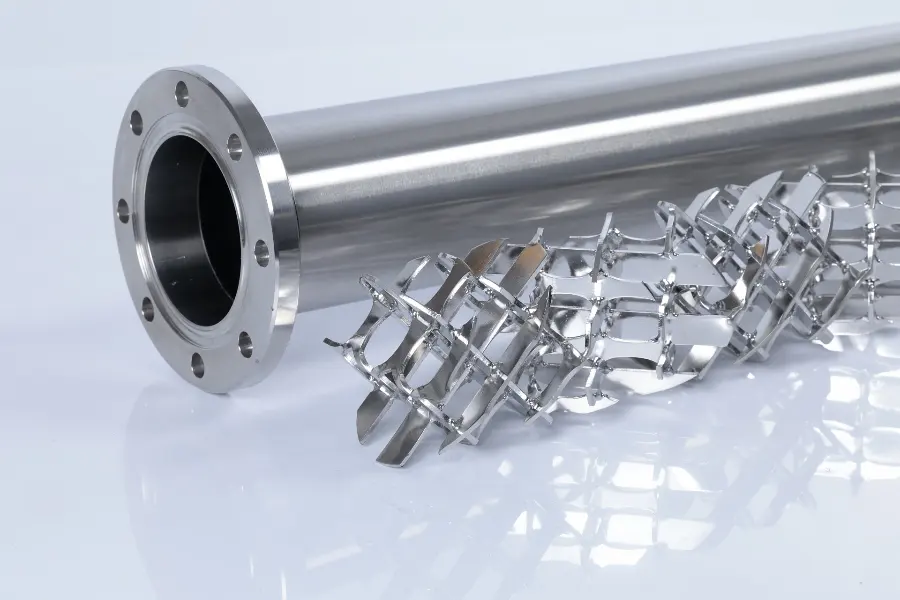
For simple blending, 6 elements are sufficient. For difficult viscosities, 12 elements ensure full homogeneity.
Not every mixing task belongs in a vessel. In continuous processes, dosing loops or rapid heating, mixing has to take place directly in the pipe. Two designs cover this: the static mixer SM, which uses the flow energy of the medium, and the dynamic tubular mixer, which uses a motor to introduce mixing energy independently of the flow rate.
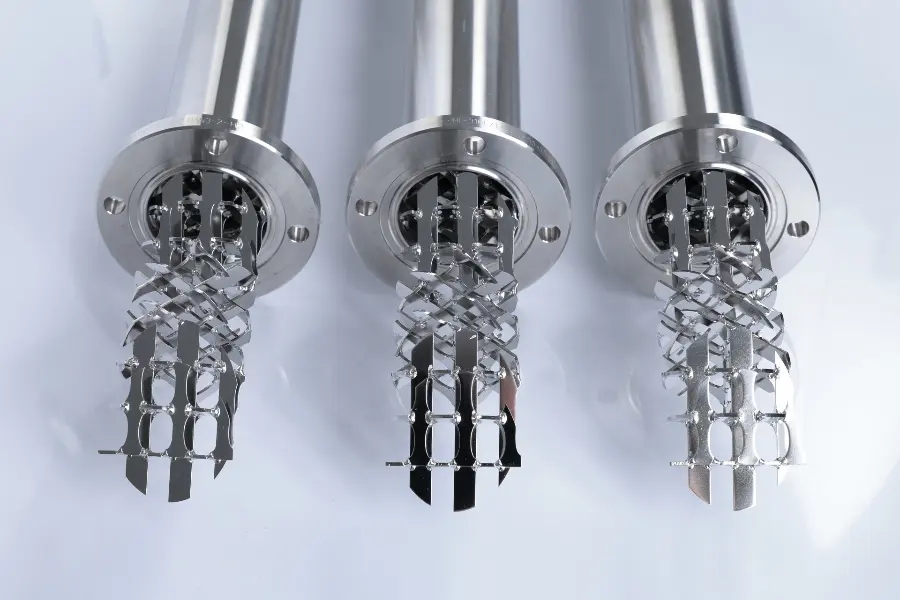
Two designs
Static mixer SM
In the
SM options
For simple blending, 6 elements are sufficient. For difficult viscosities, 12 elements ensure full homogeneity.
A nozzle introduces the additive, for example for pH adjustment or colouring, directly upstream of the first element into the centre of the flow. This improves blending and saves pipe length.
316L is the standard. For aggressive media, 2.4602 and titanium are available, and fully PTFE-lined units for aggressive acids.
Dynamic tubular mixer
In a static mixer, mixing energy depends on how fast you pump. The dynamic tubular mixer decouples the two: at a low flow rate the mixer can run at high speed and create intense shear. This is needed for stable oil-in-water emulsions or for breaking down agglomerates.
Connections and data
Both designs integrate into existing piping.
Contact
We determine design, length and material from your line. Tell us the medium, viscosity, flow rate and nominal size.
Prefer to write directly?